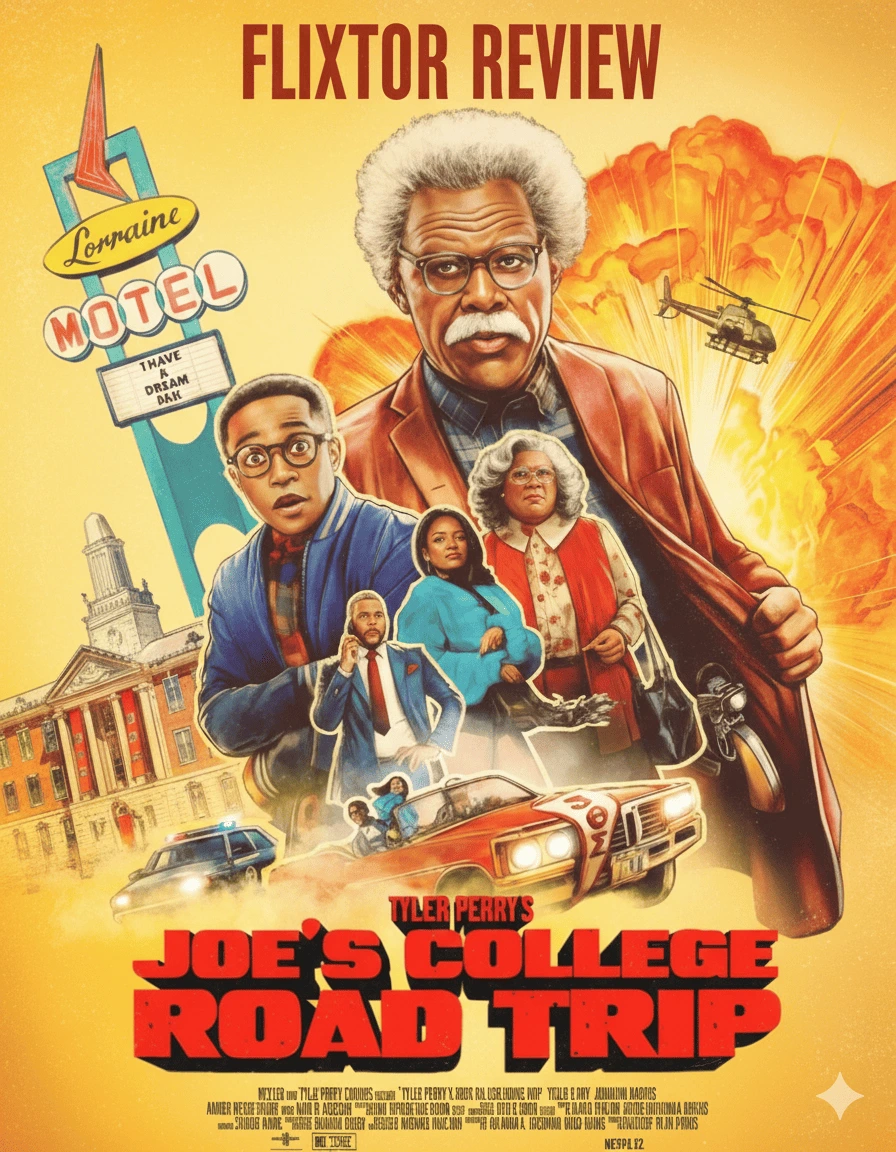
Joe’s College Road Trip
I don’t watch movies the conventional way. I rely on audio description, which means pacing, dialogue clarity, and tonal shifts register differently for me. Joe’s Collage Road Trip on flixtor, the narration for this film — produced by International Digital Center and voiced by Sri Gordon — is steady and professional. It paints the physical comedy clearly and tracks the chaos efficiently. Unfortunately, clarity in narration doesn’t equal clarity in storytelling.
And that’s where the frustration begins.
A Premise With Real Potential
At its core, this is a generational standoff disguised as a campus tour. A stubborn grandfather, a tightly wound father, and a son navigating modern identity politics collide on a road trip meant to help decide a college future. That setup is fertile ground. Conversations about historically Black colleges, cultural pride, masculinity, and evolving definitions of success could have driven a sharp, character-based story.
Instead, the film chooses exaggeration over exploration.
Joe is written at maximum volume — crude, dismissive, and emotionally allergic. The grandson operates at the opposite extreme: hyper self-aware, image-conscious, and frequently insufferable. The tension between them should evolve. It doesn’t. It just escalates in decibels.
When Loud Replaces Insight
There are moments when the script approaches something meaningful. Discussions about race in contemporary spaces, about why cultural institutions still matter, about generational disconnect — those ideas surface briefly.
Then a joke bulldozes through.
Comedy isn’t the problem. Comedy can carry serious commentary. The problem here is timing and restraint. Whenever a scene starts to sharpen into emotional honesty, it retreats into caricature. Instead of letting discomfort linger, the film rushes to defuse it.
That pattern repeats until the themes feel ornamental rather than foundational.
The Weight of Repetition
Tyler Perry is undeniably prolific. But speed can dilute intention. This road trip feels assembled rather than shaped. The emotional arcs move quickly, sometimes too quickly, as if the script knows where it wants to land but doesn’t want to do the heavy lifting to get there.
Conflict is introduced. Voices rise. A lesson appears. Resolution follows almost immediately.
Real growth doesn’t happen that cleanly — especially across generations.
A Performance That Stabilizes the Film
Amber Reign Smith’s portrayal of Destiny offers something the rest of the film struggles to maintain: grounding. Her presence shifts the tone. Where others operate in broad strokes, she plays her role with measured restraint. There’s vulnerability in her delivery that makes her character feel human rather than constructed for convenience.
When she shares scenes centered on emotional honesty rather than spectacle, the film briefly feels balanced. It’s a glimpse of what the entire project might have been if it trusted nuance more than noise.
The Missed Opportunity
The most disappointing aspect isn’t that the movie fails outright. It’s that it gestures toward relevance without committing. The intergenerational debates could have been layered. The father’s pressure could have been explored more deeply. The grandson’s worldview could have been challenged rather than simply defended or mocked.
Instead, the story opts for quick reconciliation. Disagreements soften too easily. Hard conversations resolve without lasting consequence.
It feels tidy in a way that undercuts authenticity.
Accessibility vs. Emotional Impact
From a technical accessibility standpoint, the audio description functions well. The narration keeps pace with the road trip’s constant motion and captures the visual gags without confusion. But even the clearest narration cannot compensate for tonal imbalance.
A steady voice can describe chaos, but it cannot fix it.
Final Thoughts
This film Joe’s College Road Trip on flixtor tor isn’t devoid of intention. It wants to discuss identity, legacy, and how families pass down expectations. It wants to ask whether tradition should be preserved or redefined. Those are worthy questions.
What it lacks is discipline.
The humor often overrides the message. The arguments lack sustained depth. And the emotional breakthroughs feel scripted rather than earned.
There’s a sharper, more resonant version of this story hiding beneath the surface. What we get instead is a loud, occasionally thoughtful, but ultimately uneven road trip that never fully decides whether it wants to entertain or challenge.
And in trying to do both at once, it only partially succeeds at either.