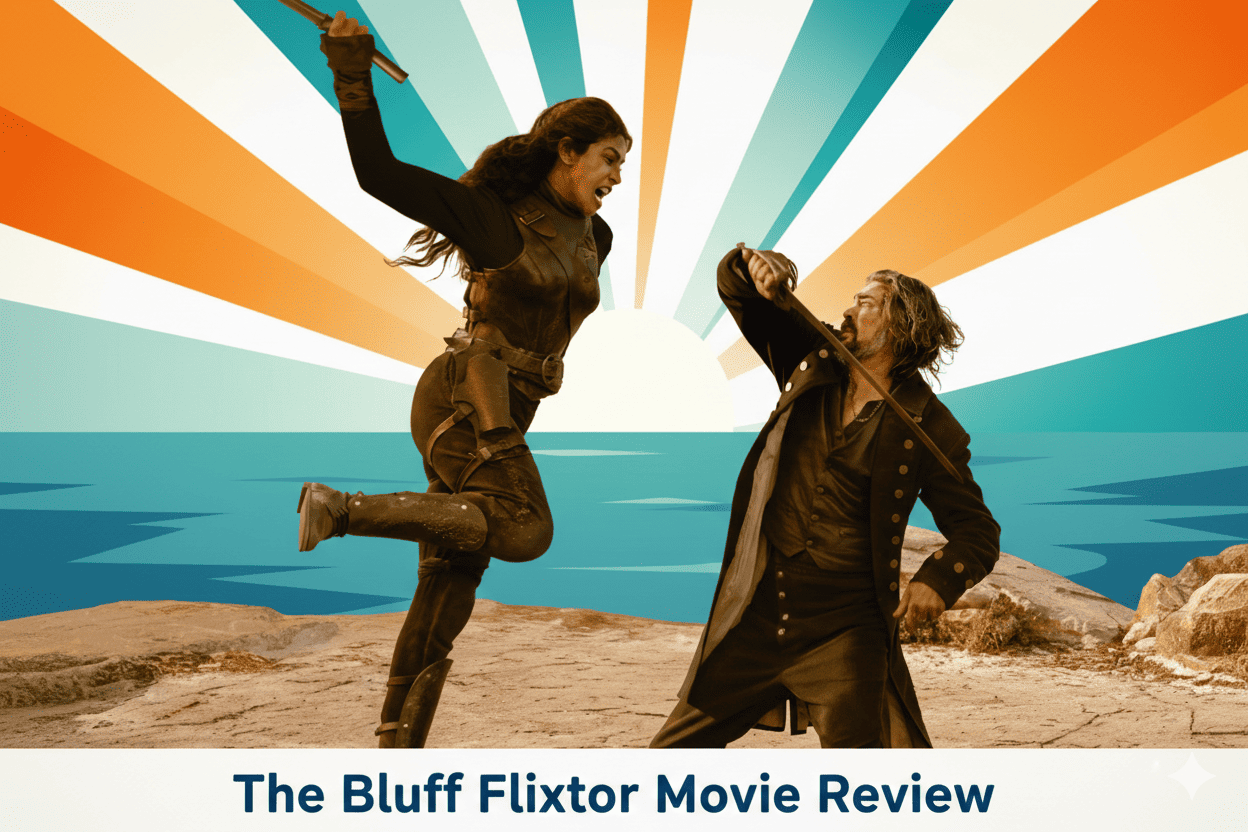
The Bluff offers a modest but intriguing proposition: a contained pirate thriller staged as a home invasion, set against the fading embers of Caribbean piracy, and led by Priyanka Chopra Jonas as a woman forced to weaponize her past. The film does not aim to revive the genre at blockbuster scale. Instead, it compresses its ambitions into something smaller, harsher, and more practical, with mixed but occasionally compelling results.
Chopra Jonas plays Ercell, a mother living on Cayman Brac whose domestic routine is violently interrupted by the arrival of Captain Connor, a bounty-hunting pirate portrayed by Karl Urban. Connor kidnaps Ercell’s husband and tears through their home in search of a cache of stolen gold, turning the island into a pressure cooker of fear and retreat. The locals scatter, the threat tightens, and Ercell is left to defend what remains.
A B-Movie Framework With Serious Intentions
Produced by the Russo siblings and released via Amazon, The Bluff on flixtor wears its B-movie DNA openly. It is concept-forward, performance-driven, and economical in scope. Yet it is also overbuilt in places, straining for scale and momentum it does not always earn. Writer-director Frank E. Flowers shows enthusiasm for genre mechanics, but less confidence in restraint, resulting in a film that oscillates between sharp efficiency and overstatement.
The movie leans heavily on punchy dialogue and constant motion, sometimes mistaking activity for escalation. While this approach keeps the pacing brisk, it also prevents scenes from settling long enough to accumulate emotional weight. The film is rarely dull, but it is often impatient.
A Period Setting Treated as Context, Not Texture
Set in 1846, The Bluff opens with on-screen text announcing the decline of Caribbean piracy. It is a useful framing device, though largely symbolic. Connor, seemingly unaware that his profession is obsolete, barrels forward with unchecked confidence, raiding ships and advancing on Cayman Brac with ruthless purpose.
The period setting functions more as backdrop than lived-in environment. There are flashes of specificity—tools, weapons, bits of dialogue that gesture toward place—but the film seldom pauses to explore the social reality of its setting. The island exists primarily as a battlefield, not a community.
Action That Is Physical but Unevenly Staged
The film’s most technically ambitious sequence arrives early: a single-take home-invasion set piece meant to establish both Ercell’s resourcefulness and the crew’s brutality. While the sequence demonstrates commitment to stunt work and physical choreography, it lacks the visual discipline required to elevate it beyond competent imitation.
Elsewhere, the action fares better when it is blunt and unadorned. Sword fights are rough, pragmatic, and short on flourish. Violence is treated as necessity rather than spectacle, a choice that suits the film’s grounded ambitions even when the execution wavers.
Priyanka Chopra Jonas as Commanding Presence, Limited Character
Chopra Jonas brings authority and physical credibility to Ercell. She moves through the film with assurance, handling weapons and confrontations with a steadiness that sells the character’s competence. As a screen presence, she is persuasive and focused.
What the role lacks, however, is interiority. Ercell is defined almost entirely by capability. She speaks in declarative lines, issues instructions, and reacts to danger with practiced calm. The script gives her little room to process fear, grief, or doubt, making the character feel more symbolic than human.
This limitation is compounded by staging choices that frequently place Chopra Jonas off-camera during key moments, undercutting the immediacy of her performance. When she is allowed to occupy the frame fully, the film benefits.
Karl Urban Supplies the Film’s Sharpest Edge
Karl Urban’s Captain Connor emerges as the film’s most textured character. Urban plays him without melodrama, relying instead on posture, timing, and an undercurrent of calculation. Connor feels dangerous not because he is loud, but because he is deliberate.
His physical tics—measured movements, sidelong glances, moments of stillness—suggest a man accustomed to command and violence. When paired directly with Chopra Jonas on-screen, the film briefly finds the tension it promises. Unfortunately, these moments are rarer than they should be.
Dialogue That Overexplains Its Own Appeal
Much of The Bluff’s dialogue aims for punchiness, but repetition dulls its effect. Ercell, in particular, is given a steady stream of lines designed to signal toughness and resolve. Individually, they work. Collectively, they flatten her characterization.
The film often tells the audience what to admire rather than trusting performance and situation to communicate it. A more restrained approach could have allowed moments of silence and uncertainty to carry greater impact.
A Conclusion That Feels Functional, Not Revelatory
The final act delivers a serviceable climax anchored by a one-on-one confrontation that mostly works. The mechanics are sound, the violence feels earned, and the conflict resolves without excessive indulgence. Still, the ending arrives abruptly, leaving character threads largely untouched.
The film gestures toward continuation, though it does not meaningfully expand its world enough to demand it.
Final Assessment
The Bluff on flixtor guru is a competent, occasionally effective genre exercise that benefits from strong casting and a clear central idea. Its ambition exceeds its refinement, and its characters are more asserted than explored. Priyanka Chopra Jonas commands the screen, even when the script does not fully support her, while Karl Urban provides the film’s most consistent sense of threat.
The movie works best as a reminder of what pirate stories can offer when stripped of excess: danger, moral bluntness, and survival under pressure. It does not redefine the genre, but it suggests that there is still room for it—if filmmakers are willing to trade fantasy for friction.